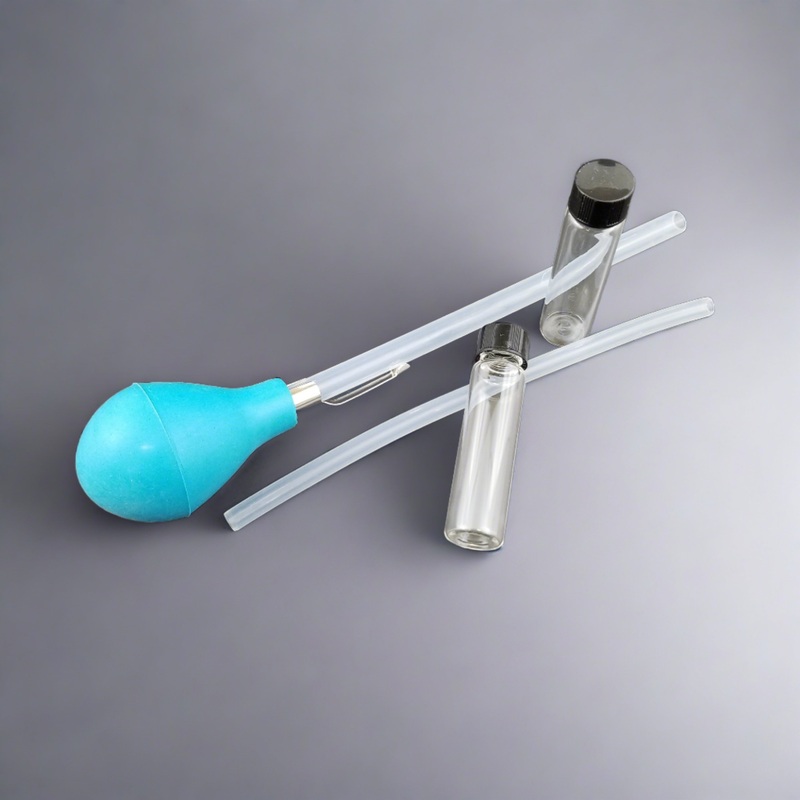
The pump is used to extract and examine the contents of the fish’s stomach. Such discovery can allow you to accurately match the food source, which leads to a more successful and informed approach. The pump is made of a rubber bulb and a small diameter plastic tapered straw which is easy to operate.
Two sizes of tubes
Tapered end
Won’t hurt fish
Clips to vest
includes 2 glass vials
Throat sampling
- Only collect samples from fish 14 or larger. Smaller trout may be harmed by the throat pump.
- Keep the trout in the net, in the water.
- Roll the trout onto its back and gently hold it still – without squeezing it – by putting one pectoral fin between your thumb and forefinger and the other pectoral fin between your forefinger and middle finger. In most cases, the trout will relax and lay still when gently held this way.
- Immerse your throat pump, squeeze the bulb and fill it with water, and then squeeze the water out.
- Gently insert the tube of the throat pump into the trouts mouth until you feel it just slip into its throat. Stop there! Do not squirt water into the trout. Release pressure on the bulb and slowly withdraw the pump tube. If theres anything in the trout youll see it enter the tube.
- Set the pump aside with the tube opening facing up so that you dont lose any contents.
- Release the trout, or if you plan to harvest it, bring it into the boat and quickly kill it.
- Squirt the contents of the pump into your vial.
- Squeeze the bulb, suck in some water, and then squirt it into the vial again. Do that one more time if your vial is large enough.
- Throat samples from actively feeding trout should contain live prey (insects, crustaceans, zooplankton, molluscs, etc.).
- If the contents are cloudy or the insects, etc. that you find are dead, you may have pushed the tube too far down the throat into the stomach and youve withdrawnstomachcontents.



Reviews
There are no reviews yet.